2026
Single-channel video with color and sound
2'52''


MORDEN WAR is an experimental video essay. The film begins with mechanical bodies and automated behaviors that increasingly permeate everyday life: moving, observing, identifying, navigating, following, and executing. Originally developed within a production system driven by convenience, efficiency, and consumption, these machines have, through continuous iteration, become cheaper, lighter, more intelligent, and easier to reproduce.
As these bodies gradually enter the realm of warfare, what changes is not merely the form of weapons.
War begins to acquire a new technological foundation: mechanical bodies that can be rapidly manufactured, continuously deployed, produced in large numbers, and constantly replaced. Warfare is therefore no longer simply a confrontation between different weapon systems. It increasingly becomes a competition between production speed, technological iteration, machine quantity, and the capacity to process information. The bodies, components, and technological capabilities accumulated by consumer industries begin to seep into a more severe reality, causing warfare to increasingly overlap with a mechanical world that once belonged to everyday life.
The work does not attempt to predict a specific future. Instead, it places realities that have already emerged alongside possibilities that have yet to occur, searching for a continuous undercurrent between the two: as technology continually pushes beyond its existing boundaries, are we merely changing the uses of machines, or are the very structures of warfare, power, and reality itself also being reshaped?


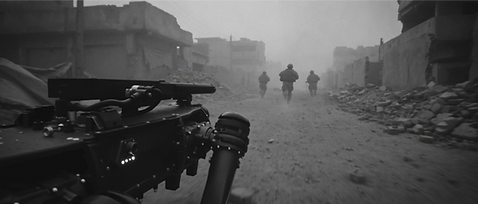


If modern warfare once operated within relatively closed technological systems, consumer-grade robotics is now beginning to loosen those boundaries.
In the past, a machine often carried a relatively clear identity from the moment it was manufactured. It was designed, produced, and placed within a predefined relationship of use. Today, this correspondence is becoming increasingly unstable. The physical body of a machine may still belong to its original world, but the range of capabilities it can perform continues to expand. Vision, positioning, movement, tracking, navigation, and execution are no longer exclusive properties of any single device, but technological conditions that can be reconnected and reorganised. What is truly changing, therefore, is not the sudden appearance of a particular kind of machine.
The change occurs when machines that already exist begin to enter another reality. Drones, quadrupedal robots, humanoid machines, and other forms of consumer-grade robotics were not originally symbols of war. They belonged to an imagination of efficiency, convenience, automation, and future life. But when these bodies become connected to more complex systems, when they are assigned new tasks, they cease to be merely products of consumer society and begin to participate in the construction of the realities of war and power.
What makes this transformation significant is not that it produces some unprecedented kind of weapon, but that it changes the way warfare depends on technology. An already mature consumer production system can continuously supply large numbers of low-cost, reproducible, and modifiable mechanical bodies; an ever-evolving software environment can continually redefine what these bodies are capable of doing. As a result, warfare begins to acquire a technological rhythm different from that of the past — faster iteration, shorter lifespans, and mechanical forms of existence that can be more easily replaced.
Machines therefore cease to be merely objects deployed into war. They gradually become part of warfare itself—something that is constantly adapting, learning, and extending itself. And the impact of this transformation does not stop at the battlefield. When technological capabilities originally developed to serve everyday life begin to enter military, political, and other highly concentrated domains of power, technological innovation is no longer simply a matter of improving the way we live. It begins to participate in determining who has faster perception, greater reach of observation, lower costs of action, and a wider capacity for execution. Technology is therefore no longer merely a mirror of reality. It begins to participate in producing reality itself.
This is also where the work seeks to maintain its critical position: technological development is often described through the language of “progress,” but progress is never abstract. Every more efficient form of perception, every more accurate judgement, every cheaper means of production, and every more autonomous form of action may produce entirely different consequences in different realities. A capability created by society for the sake of convenience may acquire an entirely different scale once it enters the structures of war and power. And as this transformation continues to occur, warfare is no longer simply a site where humans use technology. It begins, in turn, to drive technology, shape technology, and redefine what kinds of machines are considered worth producing.
A cycle therefore begins to form. Consumer society produces the bodies; technology gives those bodies new capabilities; warfare reorganises those capabilities; and new experiences of warfare then return to the technological system, becoming the basis for the next cycle of production and iteration. Within this cycle, what is most worth considering is not what machines will eventually become, but how human reality is being reshaped by them. The more machines are able to see, move, judge, and act in place of humans, the more distant the relationship between human beings and reality may become. The increasing remoteness, automation, and scalability of warfare do not merely transform action itself; they may also transform how humans understand violence, responsibility, and their own position within it.
The work therefore treats consumer-grade machines both as an unfolding historical phenomenon and as a philosophical metaphor. They represent not merely the advancement of a particular technology, but a condition in which boundaries are beginning to loosen: the once-clear distinctions between life and war, convenience and control, creation and destruction, body and tool are being increasingly penetrated. The images of wars that have already taken place are only the visible part. What continues to move forward are the changes that have not yet been fully seen—changes hidden within manufacturing, updating, replication, and use, like a slow and persistent undercurrent reshaping technology, and in turn reshaping the reality in which humanity exists.
The work ultimately does not seek to provide an answer. Instead, it hopes to leave behind a question that continues to persist:
As humans continue to create bodies capable of acting in their place, and entrust these bodies to increasingly complex systems, are machines being shaped into tools for humanity, or are humans gradually adapting themselves to a reality reorganised by machines?